For everyone
CMR: what it must contain and how to get it from the driver at once
What a CMR consignment note must contain, who gets which copy, mistakes that lead to disputes and e-CMR today. The driver's CMR photo, at once.
Published
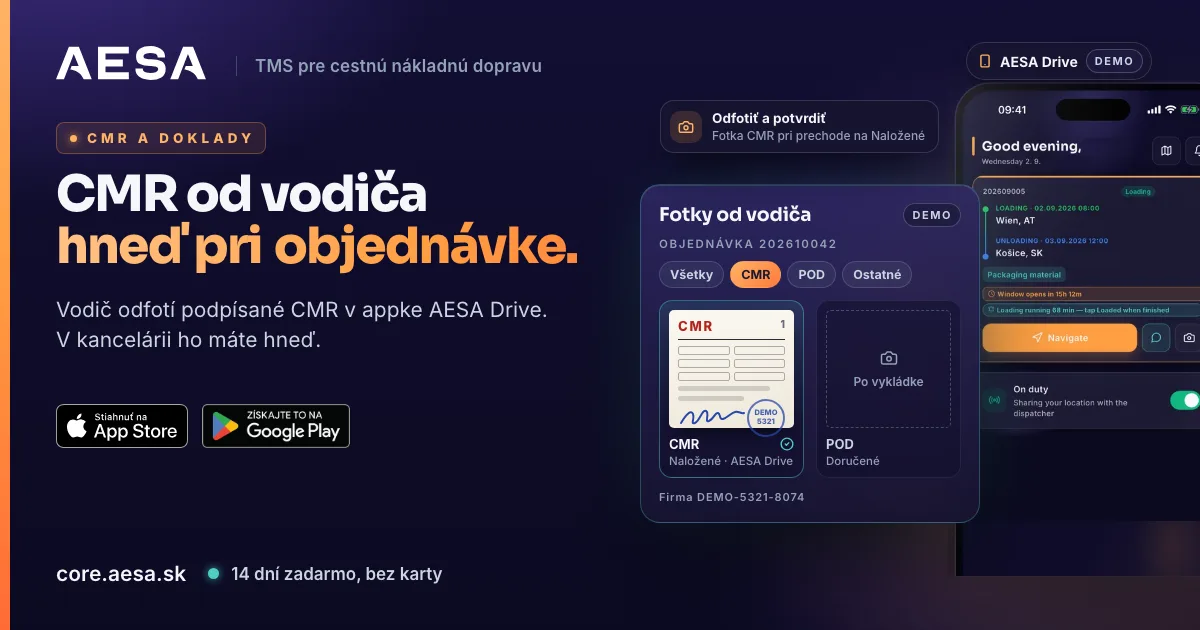
A correctly filled in and signed CMR saves you long discussions in a claim and when invoicing. Below you will find what it must contain under the CMR Convention, who gets which copy, what to watch out for and where e-CMR stands. In AESA Core TMS, the system for orders, carriers and drivers, you also have a photo of the signed CMR at the order as soon as the driver takes it.
What a CMR is
The CMR is the international consignment note for road transport. It is based on the Convention on the Contract for the International Carriage of Goods by Road, done at Geneva on 19 May 1956. The Convention applies to the carriage of goods for reward when the place of taking over and the place of delivery are in two different countries and at least one of them is a contracting country.
- It confirms the contract of carriage. If the CMR is missing or irregular, the contract remains valid (Art. 4). You lose your evidence, though.
- It is evidence. Unless the contrary is proved, it shows that the contract was made, its conditions and that the carrier received the goods (Art. 9).
What a CMR must contain
The mandatory particulars are set out in Art. 6(1) of the Convention:
- the date and place at which the consignment note is made out,
- the name and address of the sender,
- the name and address of the carrier,
- the place and date of taking over the goods and the place designated for delivery,
- the name and address of the consignee,
- the description in common use of the nature of the goods and the method of packing, and for dangerous goods their generally recognised description,
- the number of packages and their special marks and numbers,
- the gross weight of the goods or their quantity otherwise expressed,
- charges relating to the carriage (carriage charges, supplementary charges, customs duties and other charges from the making of the contract to delivery),
- the instructions required for customs and other formalities,
- a statement that the carriage is subject to the provisions of the Convention, notwithstanding any clause to the contrary.
Most forms have the last point pre-printed. If it were missing, the carrier is liable for all expenses, loss and damage caused by the omission (Art. 7(3)).
Where it applies to the consignment
Under Art. 6(2), the CMR also contains a statement that trans-shipment is not allowed, the charges the sender undertakes to pay, the cash on delivery amount, the declared value of the goods and any special interest in delivery, insurance instructions, the agreed time limit for the carriage and a list of documents handed to the carrier. The parties may add any other particulars they find useful (Art. 6(3)).
Three originals: who gets which
- Three originals signed by the sender and the carrier. The first goes to the sender, the second travels with the goods to the consignee, the third stays with the carrier (Art. 5(1)). Signatures may be printed or replaced by stamps where the law of the country in which the CMR is made out permits it.
- Forms often have more copies. The Convention requires three originals. An additional copy serves, for example, the freight forwarder.
- More trucks, more notes. When the goods are loaded onto several vehicles or are of different kinds or lots, the sender and the carrier may each require a separate CMR for each vehicle or lot (Art. 5(2)).
The copy with the consignee's signature and stamp is proof of delivery. Many companies pay for a transport only once they receive it, so it pays to have it as early as possible.
Mistakes that lead to disputes
- The consignee's signature or stamp is missing. Without them it is hard to prove that, and when, the goods were delivered.
- Driver's reservations without grounds. On taking over the goods, the carrier checks the number of packages, their marks and numbers and the apparent condition of the goods and packaging (Art. 8). What the carrier cannot check is entered as a reservation, with the grounds. Without reservations, the goods are presumed to have been in apparent good condition and the numbers to have matched (Art. 9(2)). Reservations bind the sender only if the sender expressly agreed to them in the CMR.
- Wrong weight or number of packages. The sender is liable for inaccurate particulars about the goods (Art. 7). Gross weight is also the basis of compensation: at most 8.33 units of account per kilogram of gross weight short (Art. 23(3)).
- The consignee's reservations come too late. Apparent loss or damage must be notified at the latest on delivery. Damage that is not apparent must be notified in writing within 7 days, Sundays and public holidays excepted. Compensation for delay requires a written reservation within 21 days (Art. 30).
- Time limits. Claims arising from the carriage are generally time-barred after one year (Art. 32).
A CMR is evidence. It counts exactly as it is filled in and signed.
e-CMR: where it stands in October 2026
- The protocol exists since 2008. The Additional Protocol to the CMR concerning the Electronic Consignment Note was done at Geneva on 20 February 2008 and has been in force since 5 June 2011.
- Neighbours and key markets are parties. According to the United Nations Treaty Collection, accessions include Czechia (14 April 2011), Slovakia (21 February 2014), Romania (14 March 2019), Poland (13 June 2019), Germany (5 January 2022), Austria (6 August 2024) and Hungary (28 August 2024).
- It allows, it does not require. You use an electronic consignment note when the parties to the carriage agree on it and work in a system that issues it in line with the protocol. That is why the paper CMR is still in common use. Before your first transport with e-CMR, check with your partners that it will be accepted along the whole route.
- EU authorities from July 2027. Under the eFTI Regulation (EU) 2020/1056, authorities of the Member States must, from 9 July 2027, accept transport information that companies make available electronically through a certified eFTI platform. It does not oblige companies to switch to electronic documents.
This overview is not legal advice. In a specific dispute, rely on the text of the Convention and your contract with the partner.
The driver's CMR photo at the order, at once
You fill in and sign the CMR as before. AESA Core TMS does not issue or print it. It makes sure you have the photo of the signed CMR at the order at once, not when it arrives by post.
- The driver has the AESA Drive app. You connect the driver with one code and you do not pay for drivers. Your carrier does not need to register; it is enough that their driver enters the code.
- After loading, the driver photographs the CMR. When moving to Loaded, the app asks for a photo of the CMR. The driver taps Take photo & confirm and takes the photo, or picks it from the gallery. Without a photo, the status does not change.
- After unloading, the driver photographs the proof of delivery. When moving to Delivered, the app asks for a POD photo, for example the CMR with the consignee's signature and stamp.
- In the office, you have it at once. The photo appears in transport tracking (in Orders via ⋯ → Order tracking) on the Photos tab, in the transport chat and on the timeline next to the status change. In the order detail, it is on the Documents tab, under Photos from the driver.
CMR and POD photos need a connection, and the status changes only after a successful upload. So when you see Loaded, the CMR photo is already at the order.
What you get
- An overview without phone calls. You see at once whether the driver has sent the CMR from unloading and whether it carries a signature and stamp.
- Evidence for a dispute. Photos are split into CMR, POD and other. You can download the photo manifest as CSV for an insurance claim or an audit. The same photo uploaded a second time gets the label duplicate.
- Original and scan in one place. When the original or a scan of the CMR arrives, you upload it to the order as a CMR from unloading document. This switches the transport to Delivered.
- The carrier's insurance on their card. You keep the carrier's CMR insurance, licence and contract on their card, with validity dates.
Where to find more
How to connect a driver with a code and what the driver sees in the app is explained in the article AESA Transport and AESA Drive on App Store and Google Play. How to upload documents on the web and from your phone is shown in Order documents on the web and in the mobile app. How a carrier sees its trucks and transports without phone calls is on AESA Core TMS for carriers, and for freight forwarders on AESA Core TMS for freight forwarders.
Create your company account in a few minutes. Try it free for 14 days, no payment card needed. We verify every company within 24 hours, so there are no anonymous companies on the platform.
Sources
- Convention on the Contract for the International Carriage of Goods by Road (CMR), Geneva 1956 — United Nations Treaty Collection
- Additional Protocol to the CMR concerning the Electronic Consignment Note (e-CMR), status of parties — United Nations Treaty Collection
- eFTI Regulation (EU) 2020/1056 — European Commission