Freight forwarding
How to choose a TMS for a freight forwarder: checklist
How to choose a TMS for a freight forwarder with 3 to 20 dispatchers: 12 criteria, from driver pricing and orders from PDF to EU data and export.
Published
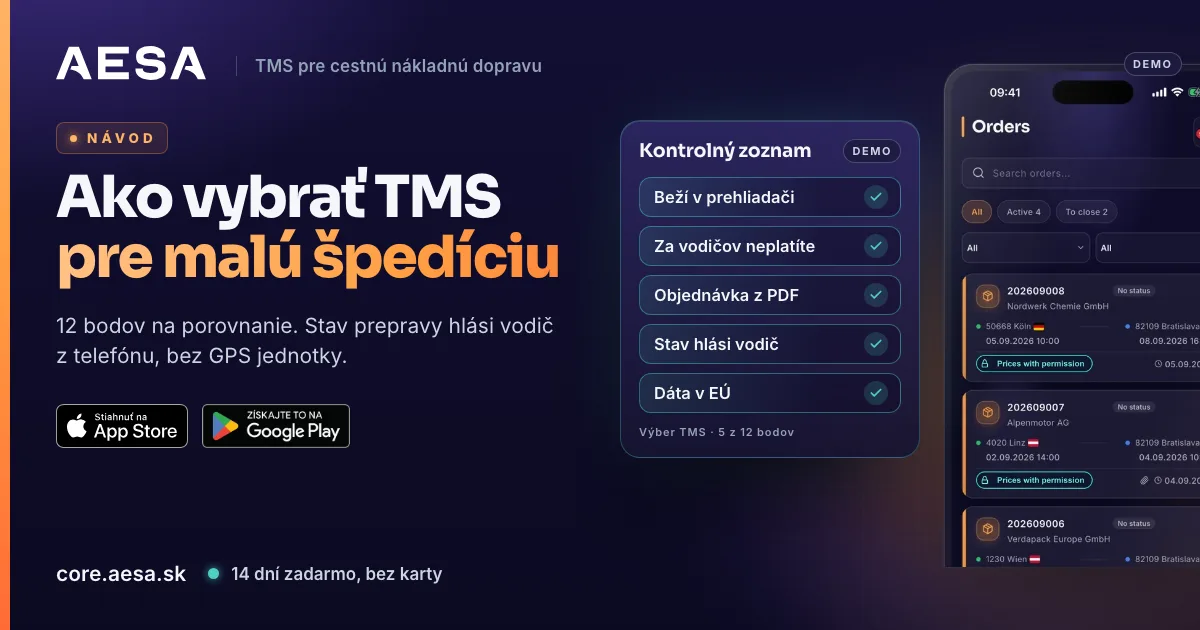
How do you choose a TMS for a freight forwarder? Compare systems against 12 criteria: how they start, what they cost per colleague and per driver, whether you can try them without a card, and how quickly they give you an order, a carrier and a shipment status. Below is a checklist for freight forwarding software for small companies with 3 to 20 dispatchers.
What is a TMS?
A TMS (transport management system) is software for managing shipments. A freight forwarder records customer orders in it, hands them to carriers and follows the status until delivery. Freight forwarding software replaces spreadsheets, e-mails and calls with one place for the whole team.
Does a small freight forwarder need a TMS?
Yes, once more than one dispatcher works on shipments. A system for a small freight forwarder should be simple, so the team can handle it without a long rollout.
How to choose a TMS for a freight forwarder: checklist
- Runs in the browser. Nothing to install, any computer.
- Clear price per user. You know in advance what each additional colleague costs.
- No fee for drivers. Drivers are not paid users.
- Trial without a card. You test the system on real shipments without a payment card.
- Order from PDF. The system fills in the customer's order.
- Status from the driver without a GPS unit. The driver reports the shipment status from a phone.
- Rights to prices and margin. You decide which colleague sees the amounts.
- Partner verification. The VAT number of the customer and carrier is checked in the EU register.
- Transport order in the carrier's language. The carrier receives a PDF they understand.
- Data in the EU and GDPR. You know where the data is stored and who processes it.
- Interface languages. Every colleague works in their own language.
- Mobile app and data export. The driver has an app and you can download your data.
What to ask when choosing
Getting started and price
A browser-based system needs no server and no administrator. On price, ask what the base includes, what an additional colleague costs and whether you also pay for drivers. You usually have more drivers than dispatchers, so this point decides the final amount.
Orders and shipment status
Retyping orders from PDF is manual work where typos happen. Ask whether the system reads the order from the PDF and fills in the fields. For tracking, find out whether the driver reports the status from a phone or whether you need a GPS unit in every truck.
Prices and partners
Not everyone needs to see the margin. Check whether the right to prices can be set for each colleague separately. For partners, ask about VAT number verification. The validity of EU VAT numbers is checked by the European Commission's VIES system. A good TMS uses it when a company is created, not only at invoicing.
Carrier and documents
The carrier should receive the transport order in a language they understand. Regulation (EU) 2020/1056 on electronic freight transport information (eFTI) sets out how companies can provide shipment data to authorities electronically. So ask whether the system keeps documents with the order in digital form.
Data, GDPR and export
Under the GDPR, the TMS provider is the processor of your customers' and drivers' personal data. Ask where the data is stored, whether you get a data processing agreement and how you download your data when you end the contract. Who inside and outside your company sees your orders is covered in the article Who sees your orders, customers and prices.
How much does a TMS for a small freight forwarder cost?
The price depends on the number of colleagues and on whether you also pay for drivers. Compare the monthly amount for the whole team including drivers, not the price of one account.
How AESA Core TMS meets these points
AESA Core TMS is a system for orders, carriers and drivers. Go through the list point by point:
- Browser. It runs at app.aesa.sk, you install nothing. Dispatchers also have the AESA Transport app.
- Price. €30 a month including the administrator account, every additional colleague €10. You do not pay for drivers. Details are in the AESA Core TMS pricing.
- Trial. 14 days free, no payment card.
- Order from PDF. You upload the customer's order as a PDF and AI fills it in.
- Shipment status. The driver reports it from the AESA Drive app, without a GPS unit. You connect a driver with one code.
- Prices. Amounts and margin are visible only to colleagues you give the right to.
- Partners. We check VAT numbers through VIES. We verify every company on the platform within 24 hours, so there are no anonymous companies here.
- Carrier. The transport order goes to the carrier as a PDF by e-mail in their language.
- Data. We process it in the EU. The owner and developer is AESA Investment OÜ, a company from the EU.
- Languages. The interface is available in 6 languages.
- Export. The administrator downloads all company data in the settings.
How a freight forwarder works in the system is shown on the page freight forwarding software. Each step is in the step-by-step guide.
Test the system on your own shipments, not on a demo.
You can create a company account in a few minutes and try it for 14 days free, no payment card.
Sources
- VIES — VAT number validation in the EU (European Commission)
- Regulation (EU) 2016/679 on the protection of personal data (GDPR) — EUR-Lex
- eFTI Regulation (EU) 2020/1056 — European Commission